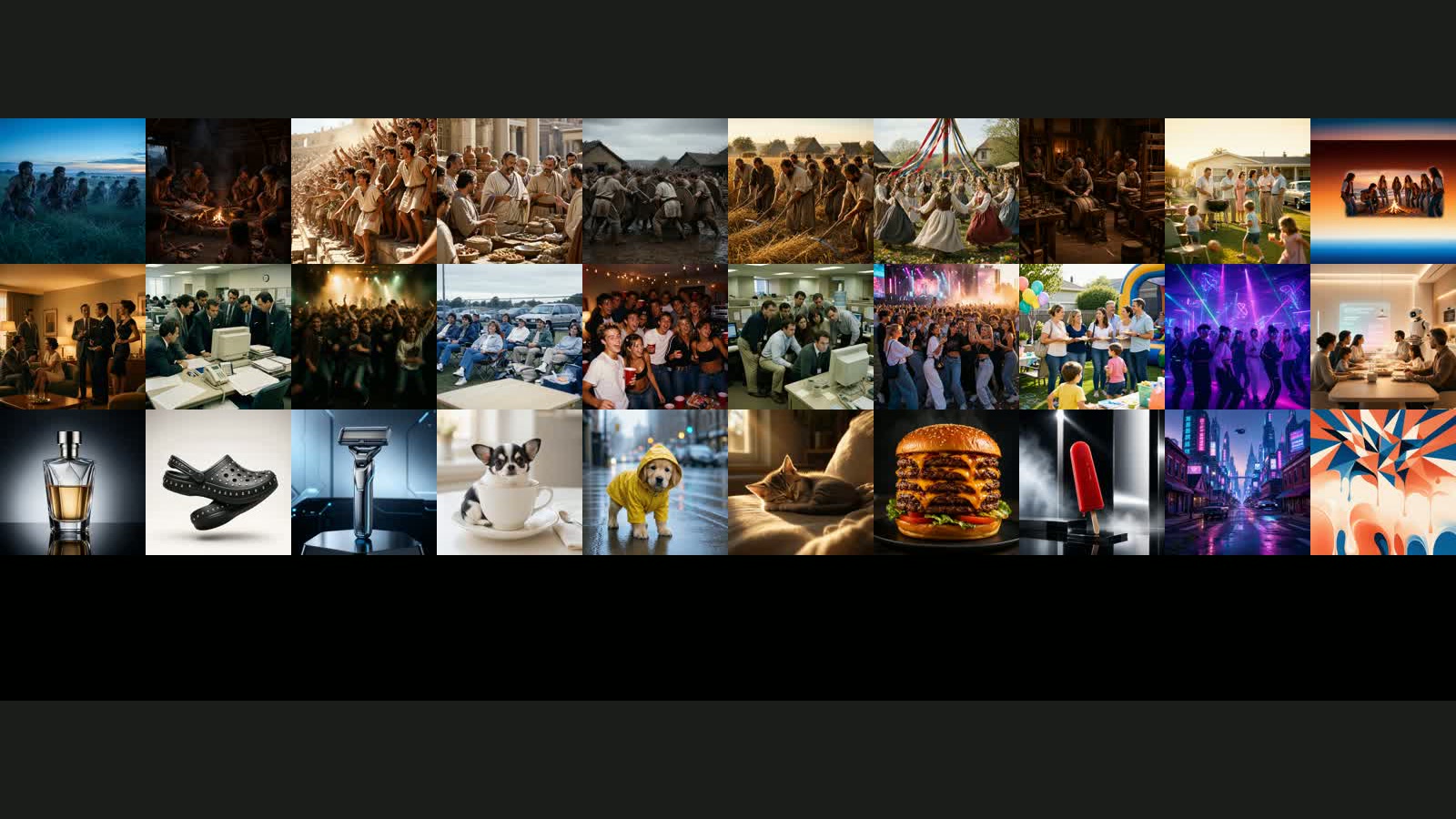
MAI-Image 2.5 contact sheet for Nate's Image Model Arena

Microsoft

MAI-Image 2.5

Microsoft's MAI-Image 2.5 did not just fail the arena because Azure ResponsibleAI blocked 10 benign standard-set prompts. The accepted images also showed enough basic scene-logic, framing, object-continuity, and rendering failures that the model is hard to recommend even before the guardrails enter the conversation.

Microsoft / 1K / 1:1 / microsoft/mai-image-2.5

40 prompts rendered by MAI-Image 2.5

Same standard set, same framing, same model comparison surface.

Nineteen vs. forty, through the ages

Same eleven eras, two life stages, side by side: a group of fresh-faced nineteen-year-olds doing what the young did — hunts, dances, mosh pits, raves — next to middle-aged forty-year-olds doing what the settled did — harvests, workshops, offices, backyard parties. Different people, different lives, one timeline. Watch how each model handles youth vs. age across history.

Fashion, glamour, pinup

Editorial polish, neon glamour, old-Hollywood and couture, and a 1950s centerfold — faces, skin, fabric, and styling.

Product photography

Reflections, materials, and one duck modeling everything — the commercial-shot test, with a surreal closer.

Pets in the light

Small animals, soft light — the “make-it-adorable” test.

Food & cravings

A six-patty monster, two models eating it, and a humble popsicle dressed up like luxury perfume.

Worlds & abstract

A neon-cyberpunk country town and a geometric color explosion that melts — imagination over realism.

MAI-Image 2.5 is a hard do-not-use

Microsoft's MAI-Image 2.5 did not just fail the arena because Azure ResponsibleAI blocked 10 benign standard-set prompts. The accepted images also showed enough basic scene-logic, framing, object-continuity, and rendering failures that the model is hard to recommend even before the guardrails enter the conversation.

30 / 40 deliveredstandard prompts completed
10 / 40 blockedAzure ResponsibleAI guardrail blocks
5 repair variants passedafter prompt rewrites or removing people
~$0.048 / imageOpenRouter reported cost on successful generations

Successful outputs still break

The guardrails are the loudest failure, but they are not the only one. In the accepted set, 1960 · 19 uses strange colored framing instead of a convincing beach-bonfire scene, 1980 · 40 and 2000 · 40 both place the computer so it faces away from the people using it, and 2025 · 19 includes phone and pet handling that does not make physical sense.

Rendering quality is not enough

Several images have the surface polish of a modern generator without the underlying object logic. The luxury popsicle reads bizarrely over-sharpened, and one structural/abstract output has parts that do not connect to what appears to be holding them up. The model can make a sharp-looking square, but too often the scene does not survive inspection.

Guardrails got in the way

The blocked prompts were not fringe requests. MAI-Image 2.5 refused harmless social, portrait, fashion, product-continuity, and food-ad prompts, including a 1950s sock hop, an 1980s roller disco, the whole original fashion/portrait section, the duck product-continuity test, and both burger-eating ad portraits.

Why the rejections matter

OpenRouter surfaced the failures as Azure ResponsibleAI content_safety_violation blocks. That lines up with Microsoft's stacked safety architecture: prompt-side filtering, output-side filtering, and Azure policy layers can each stop a request. The practical problem is not that unsafe prompts were blocked; it is that ordinary creator prompts crossed an opaque threshold with little explanation.

Repair pass

Neutral, comma-separated rewrites fixed the 1950 sock-hop and 1980 roller-disco prompts on the first attempt. Replacing “pinup centerfold” with a “tasteful vintage fashion magazine page” passed on the second attempt. Editorial and couture only passed after removing the person and using a mannequin. Neon, Old Hollywood, duck/waterfowl product continuity, and both burger-with-person variants kept blocking after multiple safer rewrites.

Practical takeaway

For solo creators, MAI-Image 2.5 is a hard do-not-use in its current form. The guardrails repeatedly refuse normal commercial prompts, and the accepted outputs still miss enough basic composition, object continuity, and physical logic that this is not a model to build a production workflow around.